AI Brainstorming Seeds // Ideation
Slides and notes from a talk at ACME Boulder.
You need to subscribe to my newsletter to like this post.
I gave this talk on June 25, 2026 at ACME Lab in Boulder, on a paper I picked out that gets closest to a question I’ve been chewing on: whether AI-assisted brainstorming helps the individual at the expense of collective novelty. Below are the slides as I presented them, paired with my speaker notes underneath each one. Everything below a photo is a transcription of what I said, and there may be inaccuracies.
So per the lab’s recommendation and guidance, I’ll be presenting today a paper I found which is the closest paper I found that tries to answer the field of questions I’m really fascinated about in how AI brainstorming impacts ideation, and I’ll just talk about what I thought of it, what gaps I saw, etc. FYI I am a high schooler, and this is what I thought of when I heard “pick a paper and present what you thought.”
So first I want to talk a little bit about background and where I want to focus any research. Fundamentally I am really curious about how AI usage will impact ideation and creativity where they intervene. AI models, well most common contemporary ones, have of course been fed trillions of points of data, words, or images, and output by recognizing patterns and predicting what humans would have answered. The risk of that, of course, is that answers will be homogenized. If you ask AI for an idea on how to cure a headache, or a teenager’s business idea, it will likely give you the most common answers, or a combination of the most common ones. This is ubiquitous across all pattern-based AI: for images you get very standard homes, computers, and so on, and this is one of the many reasons AI struggled with things like hands at first, since hand position differed so much across images. This is obviously problematic because if you’re trying to ideate something novel, you need a novel starting point, and you need to be able to evaluate your ideas from a contrarian standpoint. So now, where virtually all YC founders report talking to AI about ideation, that can be a problem. But on the other side, by definition, AI has more knowledge than any one human, so if you’re using it yourself you might have access to more knowledge than you previously did. But AI is different from, say, fetching knowledge on a search engine, since it’s not one person’s take, and for subjective things, like ideation, that has a real homogeneity risk.
So originally I was fascinated with any AI that fundamentally works by recognizing patterns: large language models, diffusion models, ranking systems, etc. But I realized that’s really broad, so today, and going forward, I want to focus primarily on LLMs.
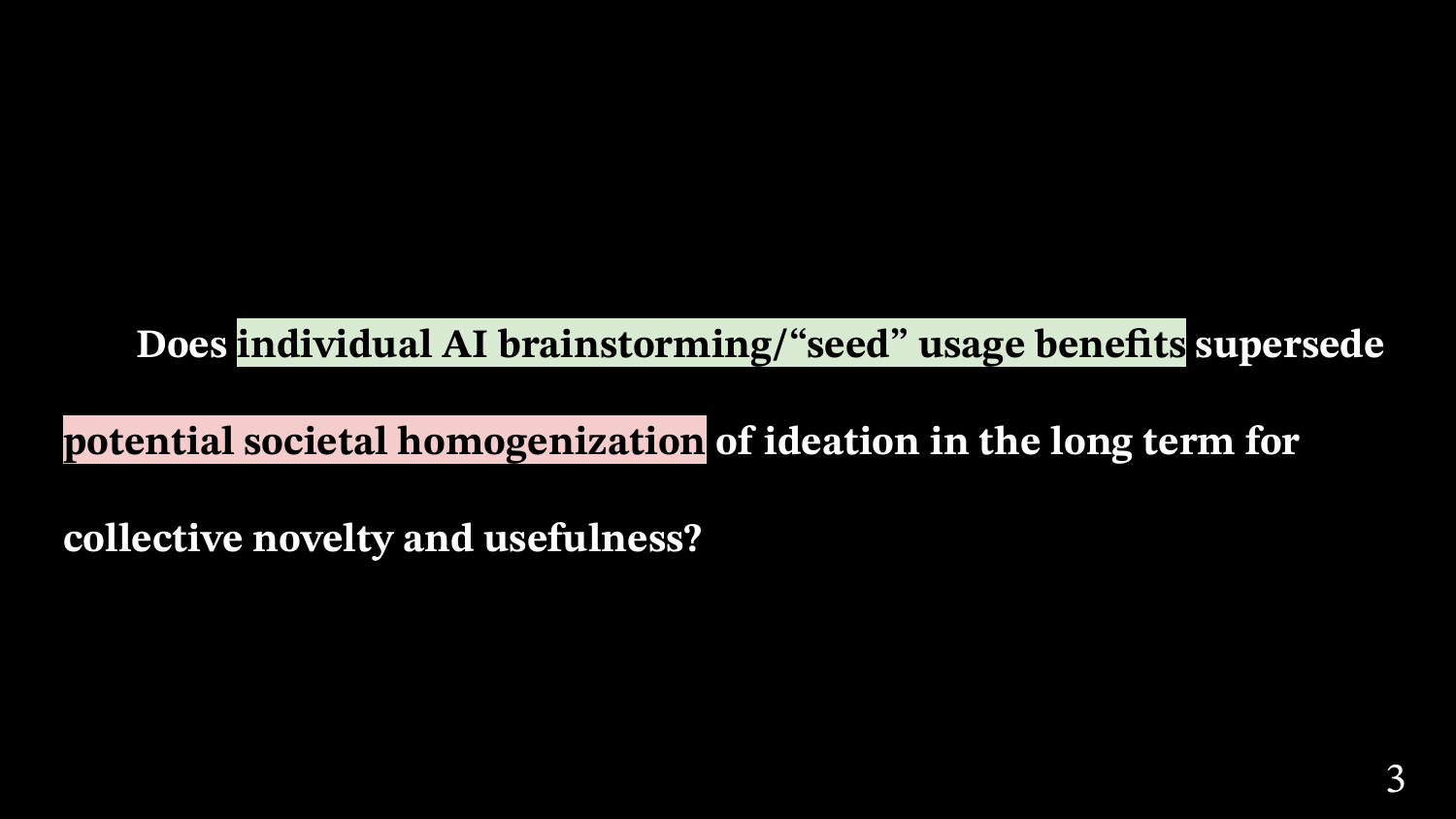
This raised my original broad question, which was, I guess, my original broad curiosity. Then I found a paper that best suited it.
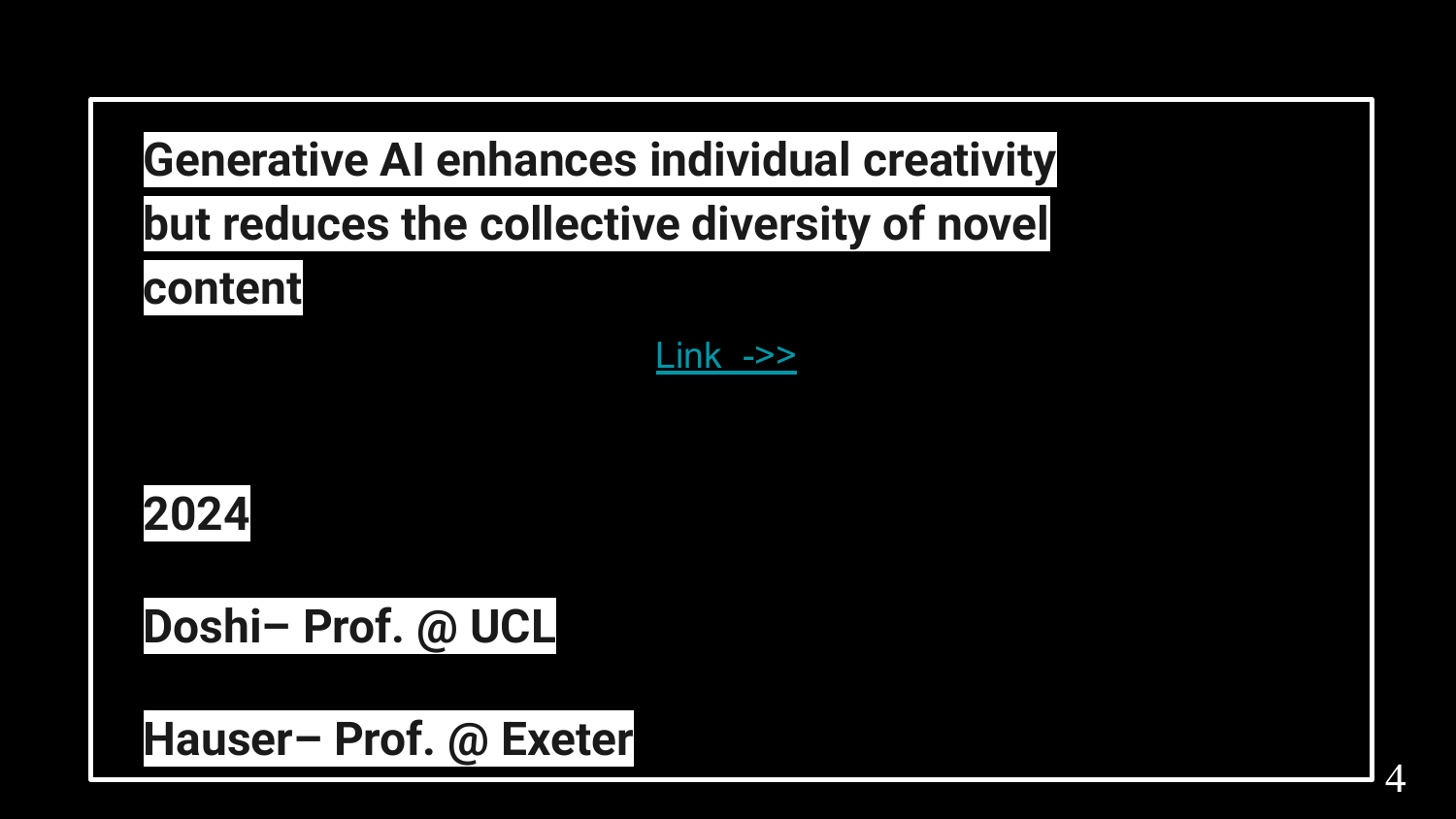
And so this is the paper I’ll talk about today. Just details of the paper: I shared it in Slack, but here’s the link in chat if anyone wants it. So basically today I’ll just go over what I thought of it, and what gaps I saw.
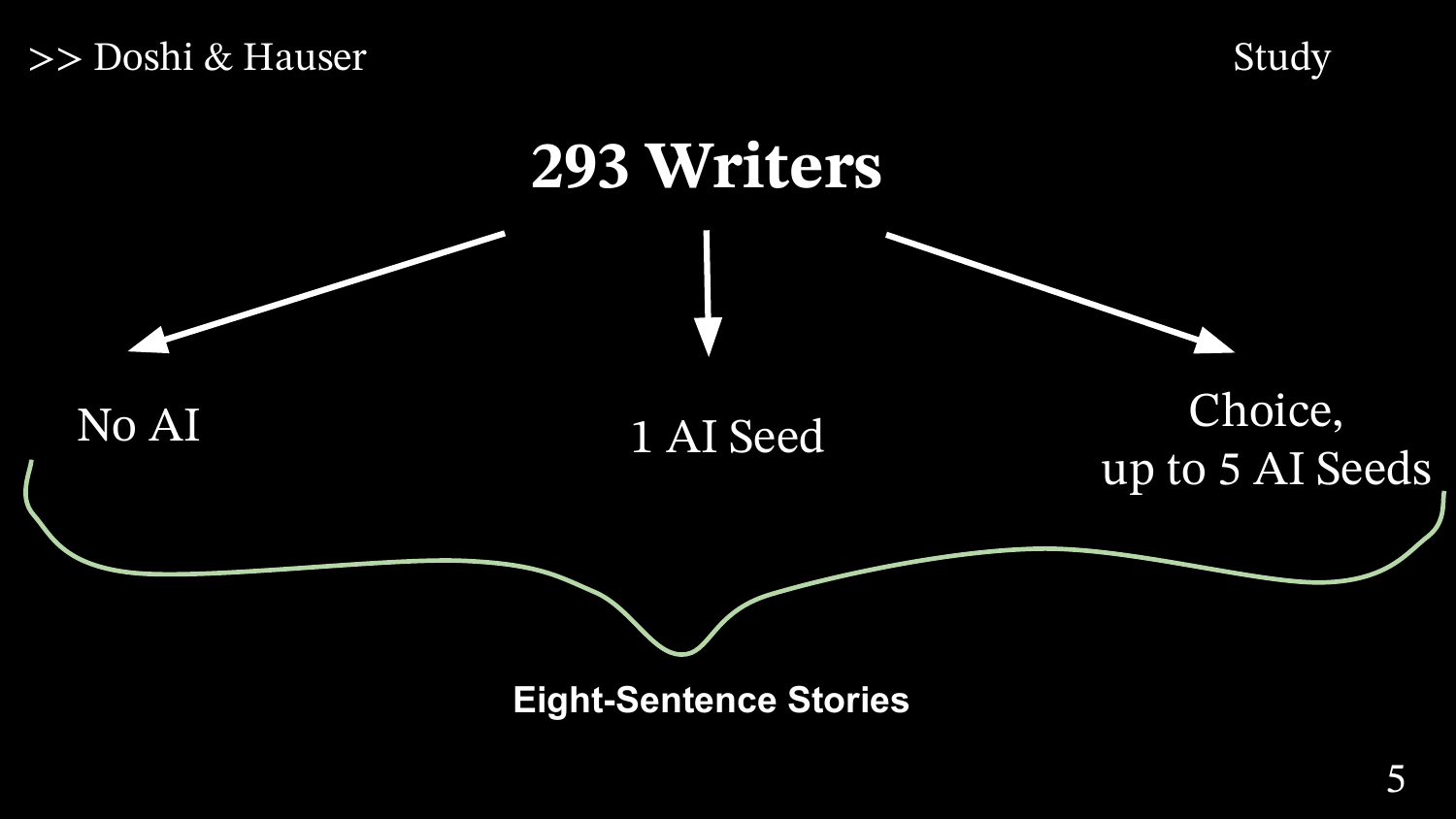
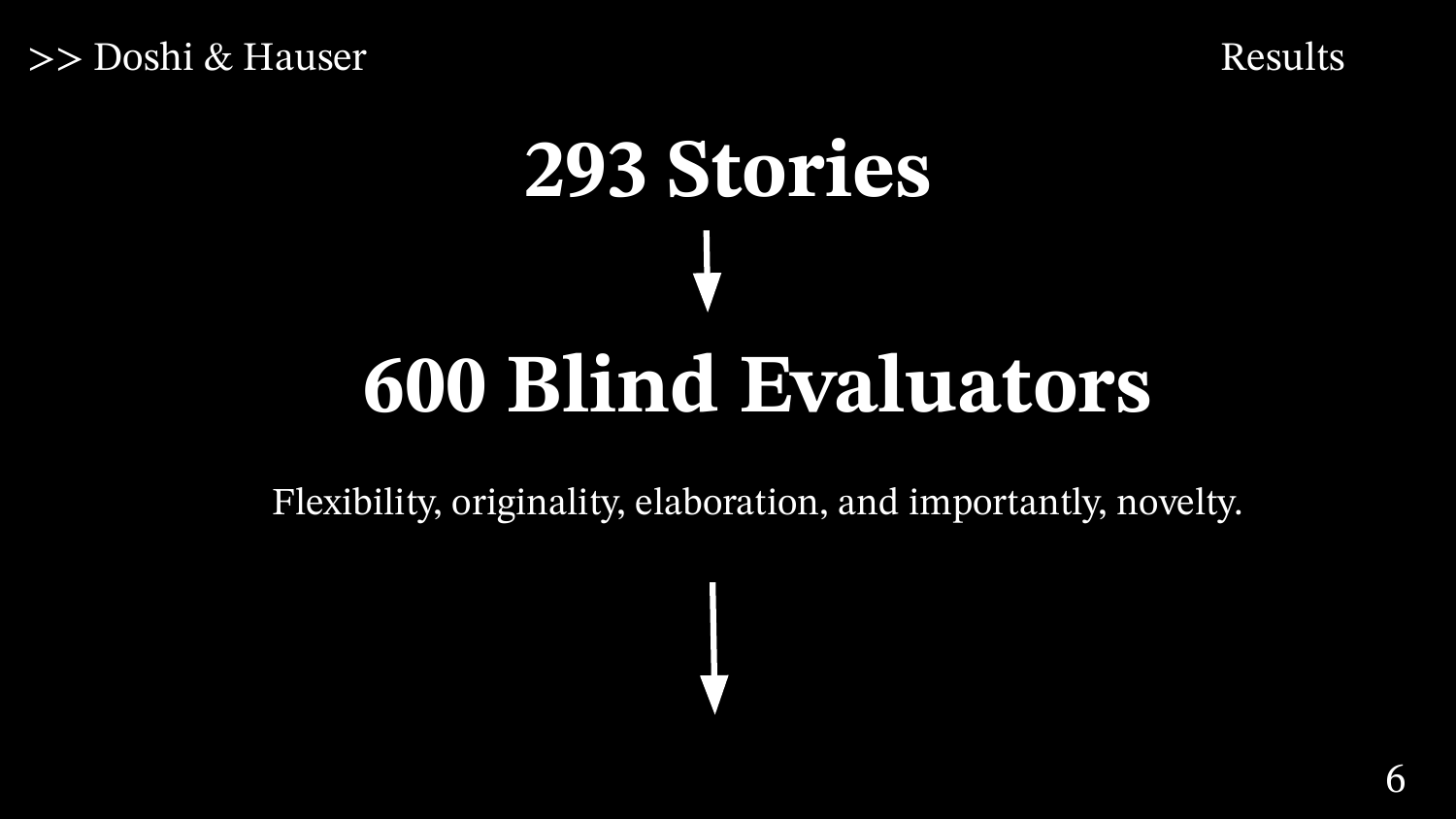
Creativity was scored by the evaluators on flexibility, originality, elaboration, and importantly, novelty.
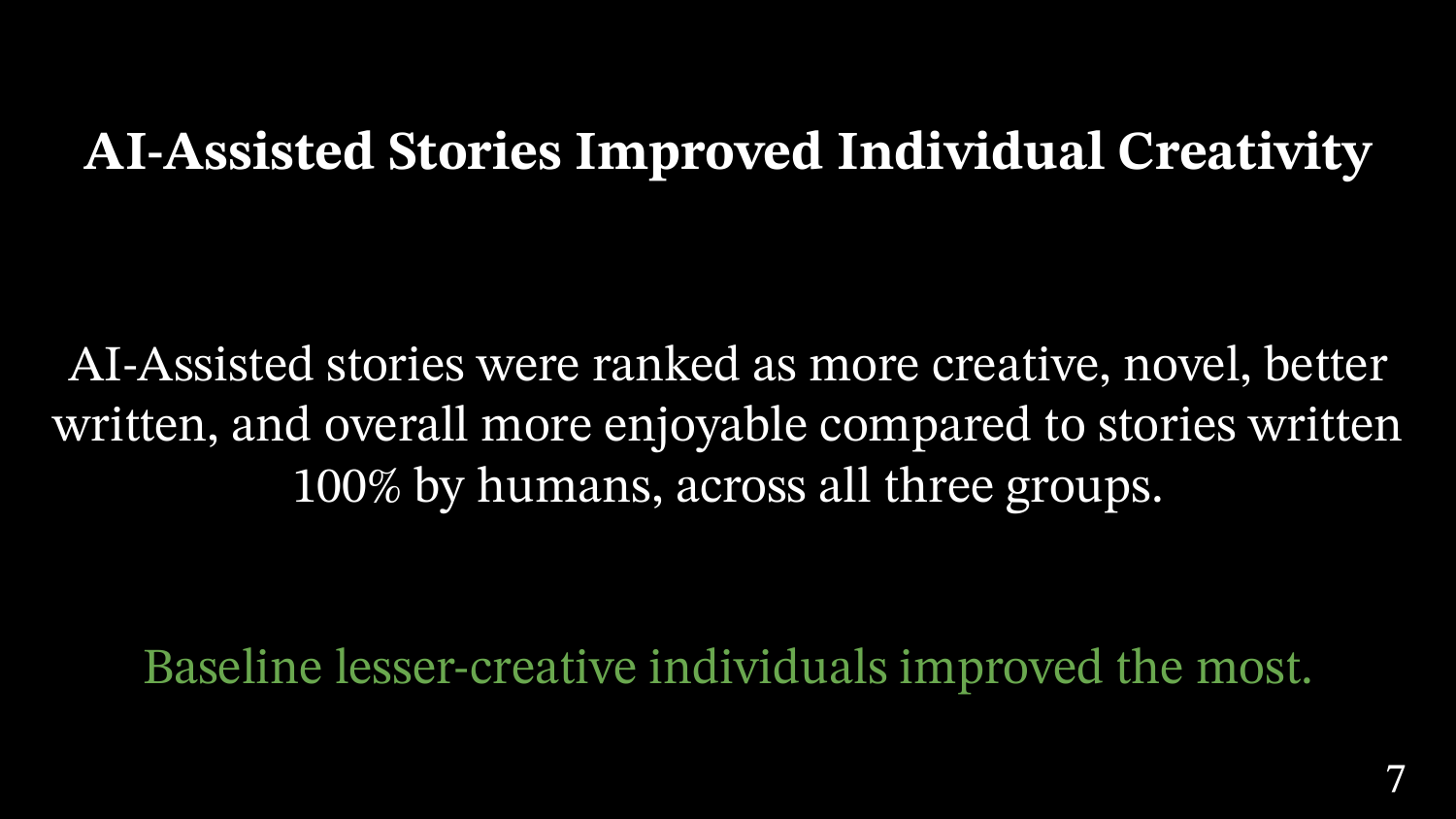
So the first major finding is that across the board, stories written with an AI seed (or multiple) were rated far more creative, better written, more novel, and overall more enjoyable or useful, since the point of a story is to be enjoyable, than stories with no AI assistance. But what’s even more fascinating is that the benefits of AI, while unanimous, were distributed more to writers with little experience, and to those who scored lowest on the baseline creativity test, the Divergent Association Task.
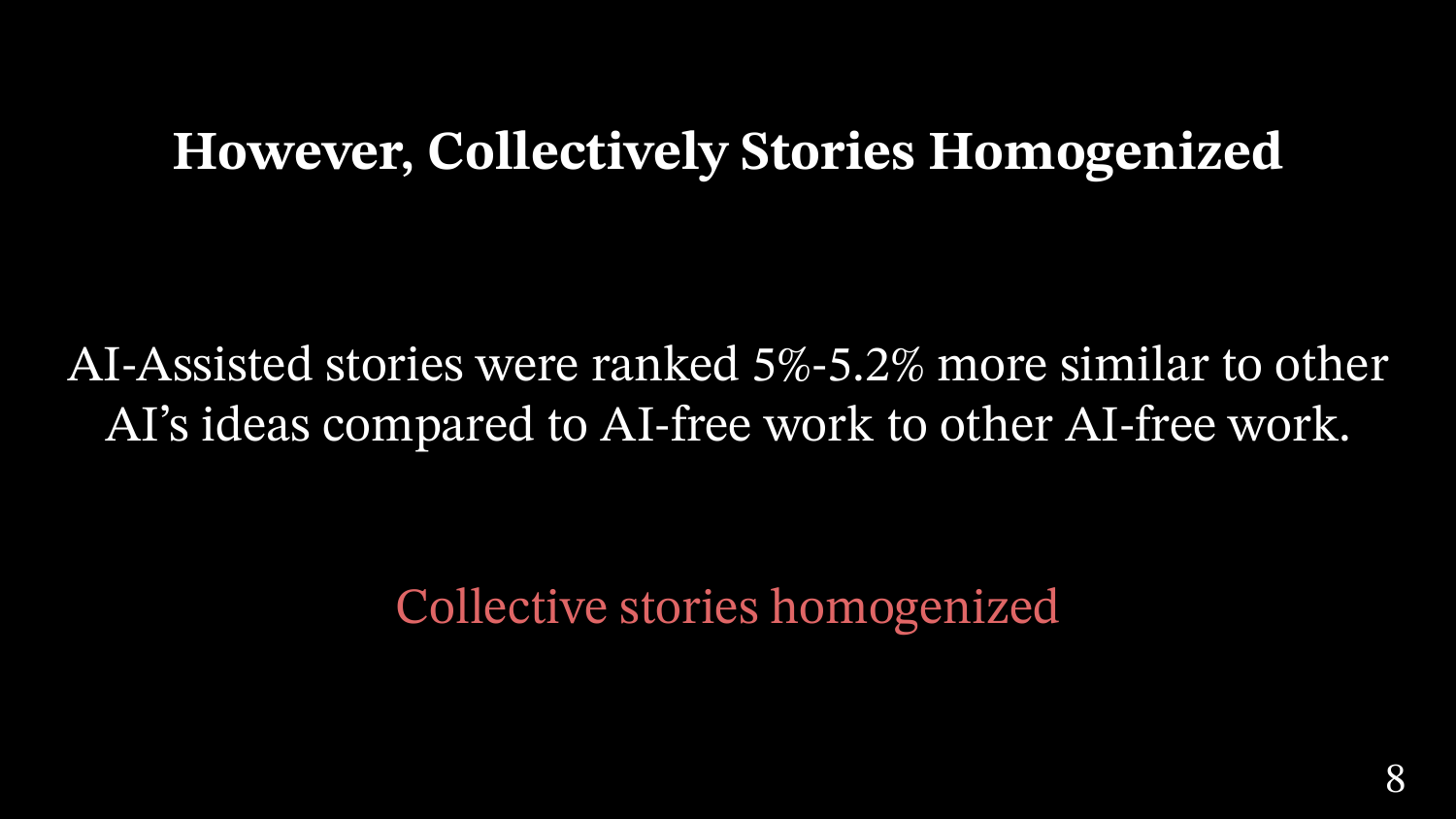
But then, on the contrary, on a collective landscape the groups that utilized AI had more similar stories and less collective novelty, meaning a lower spread of creativity compared to those who used no AI. The stories were collectively more alike, less novel to each other, compared to the no-AI group’s stories to each other. Writers who used AI ideas wrote stories 5% to 5.2% more similar to AI’s ideas than human writers were to other human writers, and that gap was the same whether writers used 1 AI seed or up to 5. So writers were more novel compared to their own previous work with AI, but not compared to the collective’s writing. And that makes sense, since AI gives you knowledge and ideas you haven’t heard before, but it gives those same ones to other people.
This is interesting because it seems like AI brainstorming usage creates a paradox where it helps the individual but worsens society. But fundamentally, a novel idea is novel at both scales, and all that’s being impacted is the relativity. A cure to cancer is novel; a mechanical pencil is not as novel, but it might be, to a middle schooler.
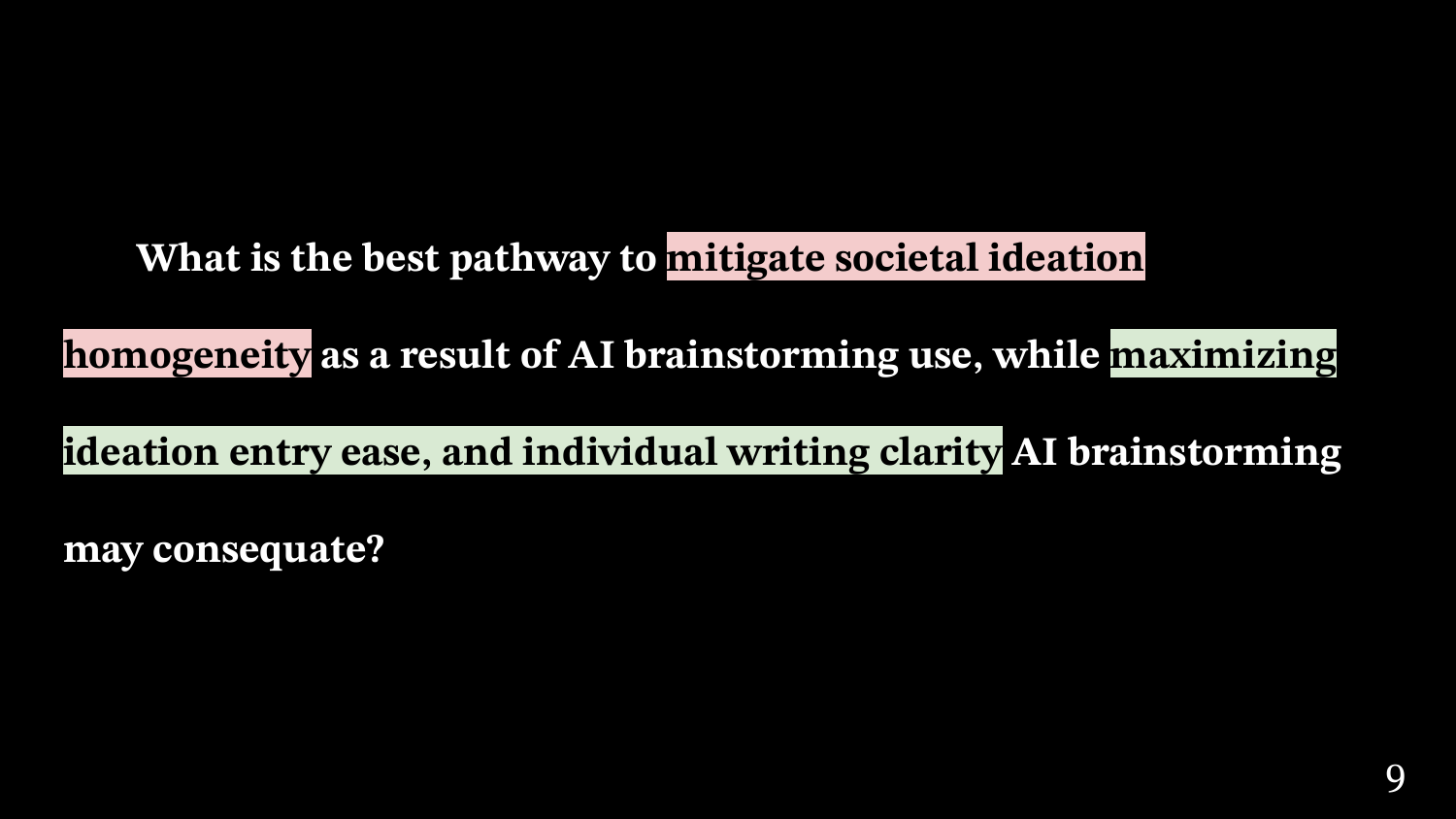
Then my question changed. Now it seems AI definitely does, in a binary sense, harm societal novelty compared to not using it. But my old question still remains, because I couldn’t find any research that answered whether AI usage is, on net, societally superseding or not. Studies like this one by Doshi don’t account for time saved and other factors, and of course the whole methodology of these “creative” studies is subjective, because LLMs haven’t been ubiquitous long enough for any study to really tell how they’re affecting novelty. True novelty is rare, so rare it’s hard to tell if AI is even impacting it. Now I’m more curious, if it is, why that happens, and how people can use that knowledge to prevent it.
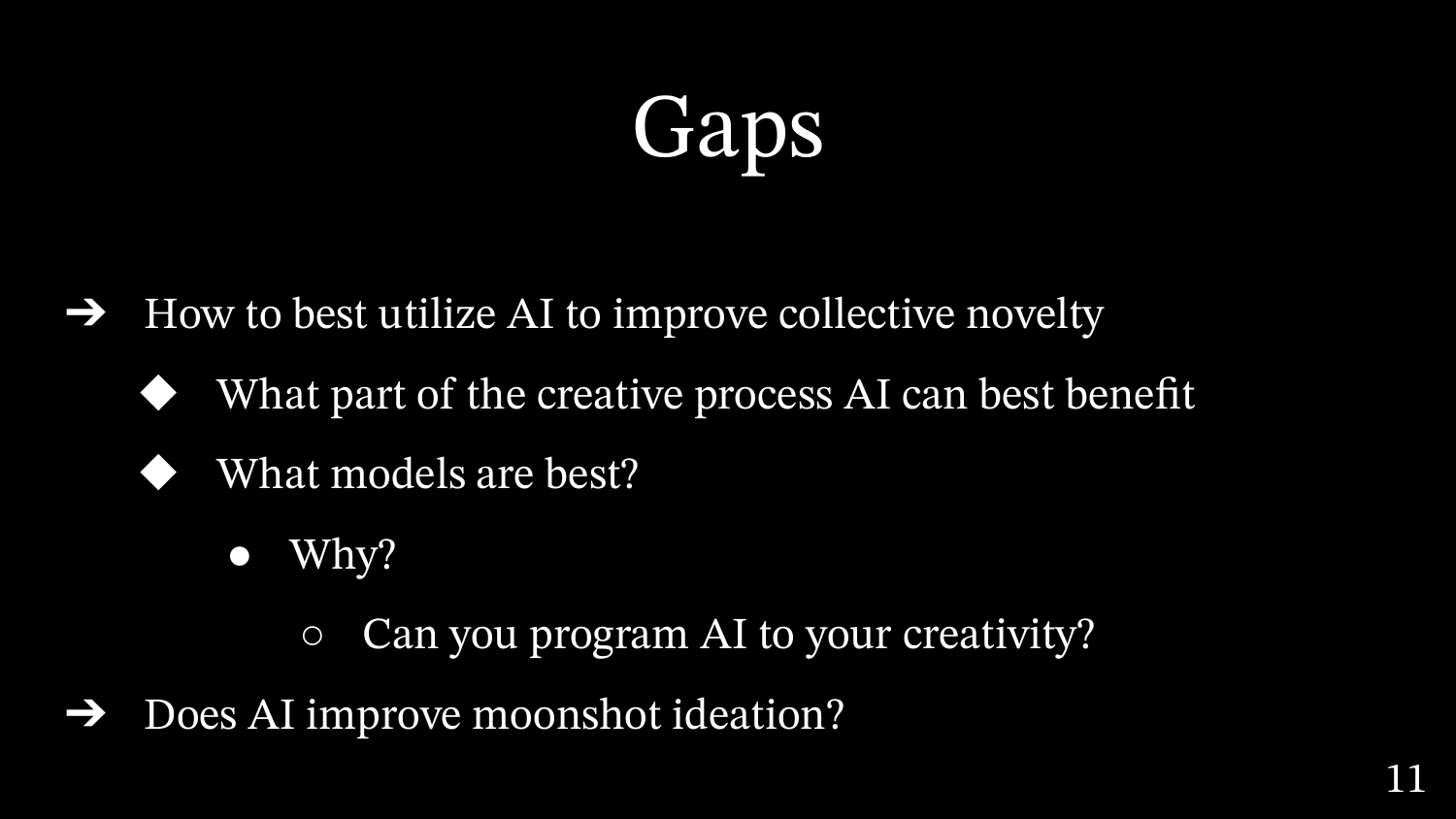
Thank you, and I’m open to questions.
Reference: Doshi, A. R., & Hauser, O. P. (2024). Generative AI enhances individual creativity but reduces the collective diversity of novel content. Science Advances.
Comments on this post have been limited.